
Every full-size doll has a metal skeleton inside it, and the type of skeleton is one of the biggest things a spec sheet tells you that a photo never will. It decides how the doll holds a pose, how heavy it feels to move, how much it costs, and eventually what breaks first. Most first-time buyers skip straight past this line on the product page. It’s worth thirty seconds of attention before you order.
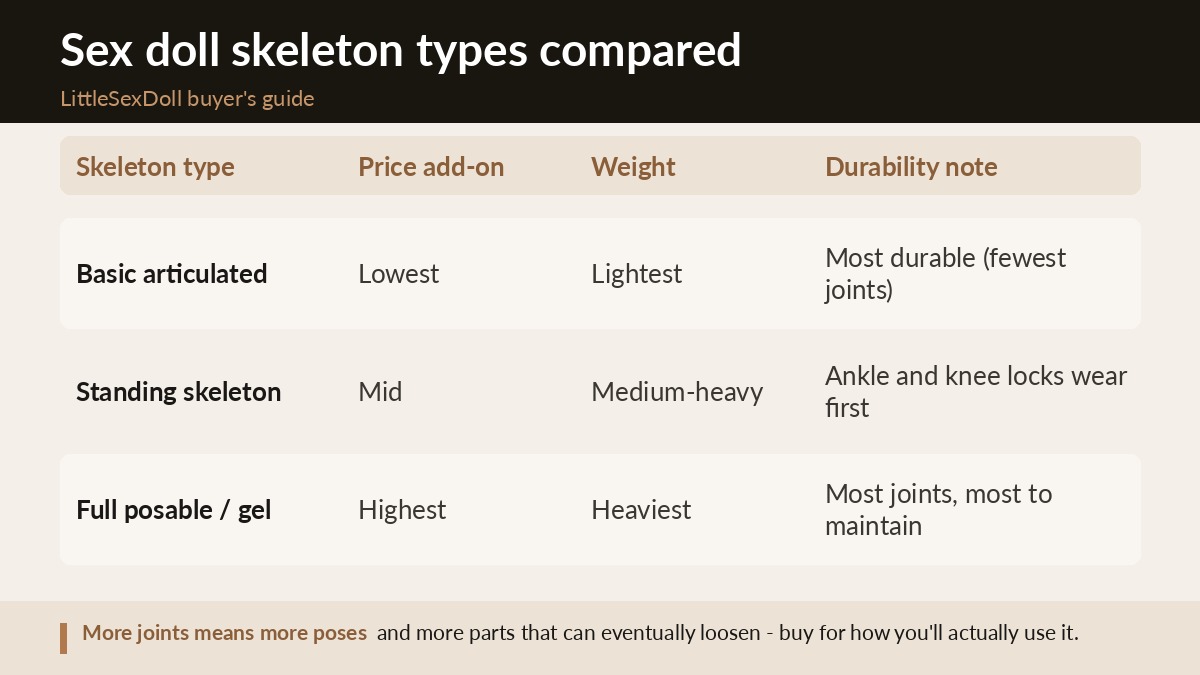
The three skeletons you’ll actually see
Almost every listing falls into one of three buckets, whatever brand-specific name the seller gives it.
- Basic articulated frame. Steel joints at the neck, shoulders, elbows, hips, and knees, no standing lock. This is the entry-level skeleton on almost every budget doll and it’s genuinely fine for most people — it holds a seated or lying pose without trouble, it’s the lightest option, and it’s the cheapest to replace if a joint ever fails.
- Standing skeleton. Adds locking mechanisms at the ankles, knees, and hips so the doll can hold an upright pose against a wall or with light support. It adds weight and cost, and the “standing” claim is usually more limited in practice than the marketing photo suggests — free-standing without any support is rare even with this upgrade.
- Full posable / gel-reinforced frame. The premium tier. More joint points, sometimes a gel layer around the steel to soften the movement and reduce the “robotic” feel, and better range of motion at the waist and neck. This is the frame you want if fine-tuned posing matters to you, and it’s priced accordingly.
What the upgrade actually buys you
The jump from basic to standing typically adds a meaningful amount to the final price and a bit of extra weight, concentrated in the ankles and lower legs where the locking hardware sits. The jump to a full posable frame adds more again, mostly because the joint count goes up and each one is a manufactured part with its own quality control. None of this shows up clearly in a thumbnail photo, which is exactly why it’s worth reading the actual spec sheet instead of judging a listing on the cover image.
What breaks, and how often
More joints mean more individual points that can eventually loosen or fail, so the posable frame isn’t automatically “better built,” it’s a different tradeoff. A basic frame has fewer things to go wrong but less flexibility. A standing frame concentrates extra stress on the ankle and knee locks specifically, since that’s the hardware doing the work of holding weight upright. In practice, the single most common failure across all three types isn’t the skeleton itself, it’s the material around a joint wearing thin from repeated bending in the same spot, which is a care issue more than a skeleton-quality issue.
How to pick
If this is your first doll, the basic articulated frame is the reasonable default. It’s lighter to handle, cheaper to replace if something goes wrong, and does everything most owners actually use day to day. Pay for the standing upgrade only if you have a specific spot, like against a closet wall, where you actually intend to keep it upright, since the real-world standing performance is more limited than it looks in promotional photos. The full posable frame is worth the premium mainly for buyers who care about fine positioning and don’t mind the added weight and price. There’s no wrong answer here, just a mismatch to avoid: buying the standing or posable upgrade for features you were never going to use, when the money would have been better spent on material grade or a second wig.