
Standing feet show up as a checkbox add-on across most product listings, usually with a promotional photo of the doll upright and unsupported. The real-world result is more modest than that photo suggests. Here’s what the upgrade actually gets you.
What the upgrade actually is
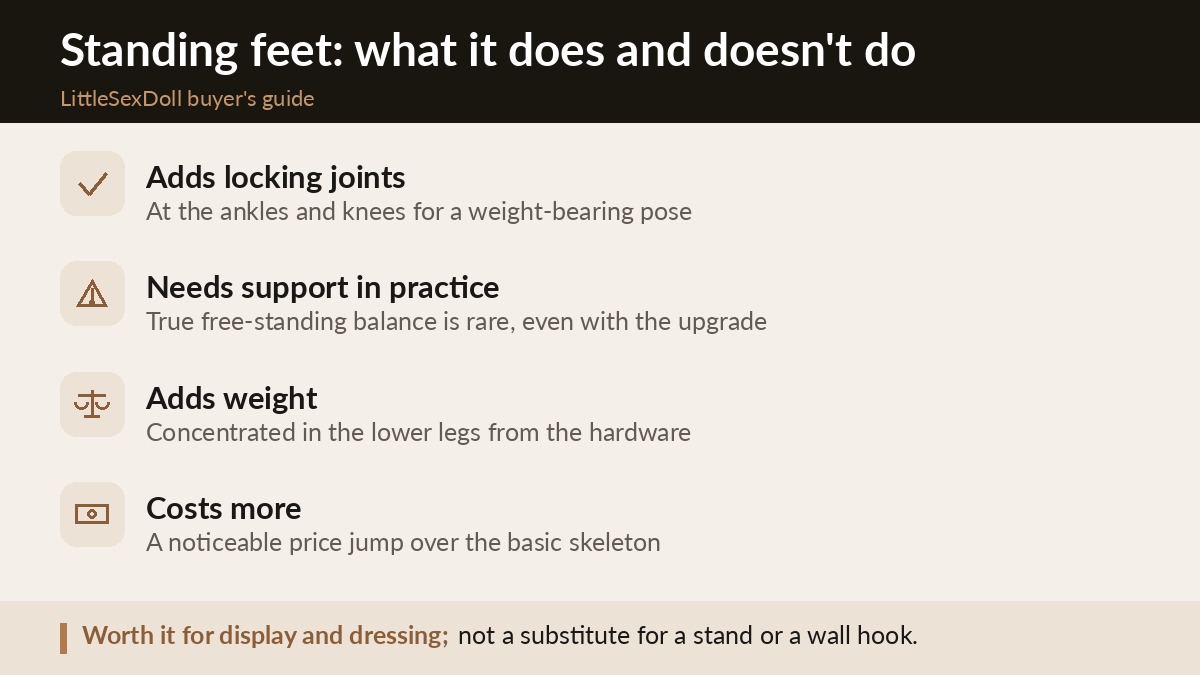
Standing feet add locking joints at the ankles and knees so the leg can hold a straight, weight-bearing position instead of only bending. It’s a skeleton-level change, not a cosmetic one, which is why it has to be selected at order time rather than added afterward in most cases.
The catch almost nobody mentions upfront
True free-standing balance, no wall, no stand, no support of any kind, is genuinely rare even with this upgrade. Center of gravity, foot size, and floor surface all affect it, and most owners end up using a wall, a piece of furniture, or a dedicated stand anyway. Think of the upgrade as “can hold an upright pose with light support” rather than “stands on its own like a mannequin,” and you’ll have accurate expectations going in.
What it costs you beyond money
- Extra weight, concentrated in the lower legs where the locking hardware sits.
- More points that can eventually loosen, since the ankle and knee locks do real mechanical work every time they’re used.
- A higher price, typically a noticeable jump over the basic skeleton.
Is it worth it for you
Worth it if you have a specific spot, a wall corner, a stand you already plan to buy, where an upright pose is something you’ll actually use regularly. Not worth it if you were picturing the free-standing display photo and don’t have a support setup in mind, since the honest result is closer to “upright with help” than “upright on its own.” A basic skeleton with a simple wall or furniture support achieves a similar look for a lot less money in that case.